



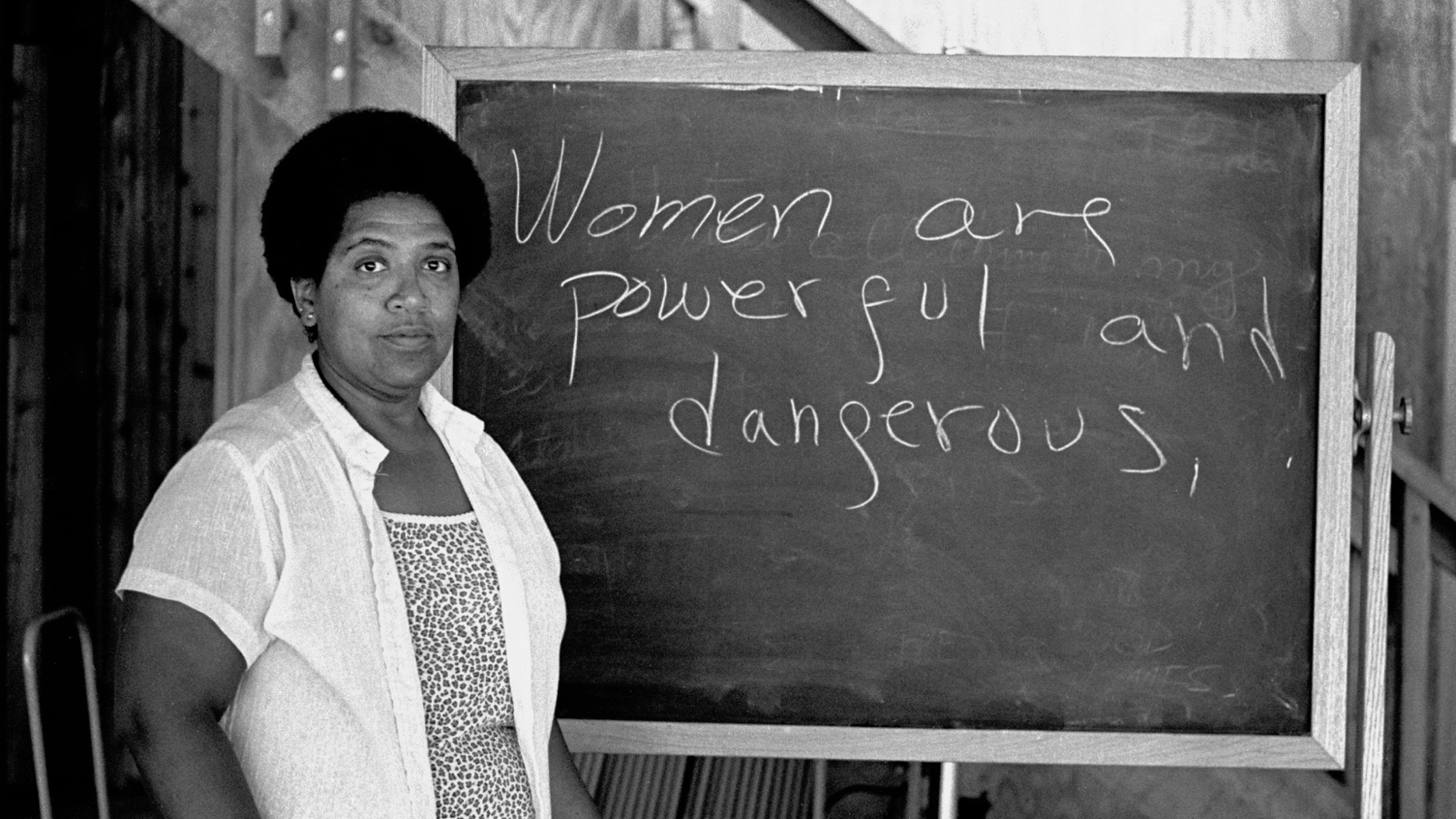
“Don’t mythologize me,” Audre Lorde told her partner Gloria Joseph. Joseph recalled the instruction to the St. Croix Source in 2016, when she had a book of recollections of Lorde to discuss. Some 50 people contributed to The Wind Is Spirit: The Life, Love and Legacy of Audre Lorde. A famously quotable writer had asked to be remembered as a person.
Born in 1934 and dead at 58 in 1992, Lorde left poems, speeches, essays and Zami, the book she called a biomythography. She was a Black lesbian New Yorker, a daughter of Caribbean immigrants, a librarian and a mother of two. Her account of breast cancer and a mastectomy became The Cancer Journals. Sister Outsider collected speeches and essays that readers still seek out, sometimes after encountering a single sentence from them.
Audre Lorde’s Harlem Childhood and Caribbean Roots
Audre Lorde was born on Feb. 18, 1934, in Harlem. Barbados was her father’s birthplace; Grenada was her mother’s. Their names were Frederic Byron Lorde and Linda Belmar Lorde, respectively, as recorded in the Gale biographical entries at Encyclopedia.com. Linda’s island, Carriacou, would give her daughter a book title.
Lorde spent 1954 studying in Mexico. Back in New York, she finished her degree at Hunter College in 1959 and went on to Columbia for a master’s in library science (1961). The chronology in Spelman’s Lorde archive follows her through library work, marriage to the attorney Edwin Rollins in 1962, and the births of Elizabeth and Jonathan. Lorde and Rollins divorced in 1970.
The 1968 publication of The First Cities coincided with a move into teaching poetry. Lorde went to Mississippi as poet-in-residence at Tougaloo College on a National Endowment for the Arts grant. Both the book and the appointment appear in the New York State Writers Institute’s account of her career.
Black, Lesbian, Mother, Warrior, Poet
Lorde described herself as “Black, lesbian, mother, warrior, poet,” the formulation reproduced on Silver Press’s page about her writing. None of the five words is a qualification of another. That mattered in movements where she challenged whose experiences got heard. In 1983, speaking at the 20th-anniversary March on Washington, Lorde announced that she represented the National Coalition of Black Lesbians and Gays, the St. Croix Source recalls. At least five volumes of poetry were behind her by then, as were The Cancer Journals and Zami; Sister Outsider was still a year off.
Joseph was Lorde’s partner in her last years. An educator and activist, she lived with Lorde on St. Croix in the U.S. Virgin Islands. The recollections Joseph later gathered for The Wind Is Spirit put friends’ and colleagues’ memories beside the public record.
Audre Lorde Books, 1968 to 1988: A Dated List
A first-edition date can be surprisingly hard to spot among reprints. Here are nine books with their original years and publishers, checked against the Writers Institute’s bibliography. Zami, for example, first appeared at Persephone Press, though readers may know a Crossing Press edition.
| Book | Year | Type | Publisher and notes |
|---|---|---|---|
| The First Cities | 1968 | Poetry | Poets Press; her first book |
| Cables to Rage | 1970 | Poetry | Paul Breman, London |
| From a Land Where Other People Live | 1973 | Poetry | Broadside Press; National Book Award nominee, 1974 |
| Coal | 1976 | Poetry | W.W. Norton |
| The Black Unicorn | 1978 | Poetry | W.W. Norton |
| The Cancer Journals | 1980 | Nonfiction | Spinsters Ink; ALA Gay Caucus Book of the Year, 1981 |
| Zami: A New Spelling of My Name | 1982 | Biomythography | Persephone Press (Watertown, Mass.); later reissued by Crossing Press |
| Sister Outsider | 1984 | Essays and speeches | Crossing Press |
| A Burst of Light | 1988 | Essays | Firebrand Books; American Book Award, 1989 |
‘Zami,’ Carriacou and Lorde’s Idea of Biomythography
What sort of book is a biomythography? In Lorde’s usage, history and myth join biography. Zami: A New Spelling of My Name follows her Harlem childhood and her coming out in the 1950s. At the end, in the epilogue, she explains the Carriacou word: “women who work together as friends and lovers.” EBSCO’s account of Zami reproduces the definition.
Carriacou is part of Grenada, and Lorde’s connection to it came through her mother. The title is a reminder that lesbian language has more than one point of origin. Sappho’s island, Lesbos, is familiar; Lorde chose a word from her own family’s island. In the book are Harlem, Mexico, and women loving women in 1950s New York. A reader arriving for the coming-out story will also find the story of a daughter.
‘Sister Outsider’ and ‘The Master’s Tools’ Essay of 1979
“The Master’s Tools Will Never Dismantle the Master’s House” dates to 1979. Lorde addressed the mostly white organizers of the Second Sex Conference, a setting described in Publishers Weekly’s review of her selected work. It became one of the essays and speeches gathered in Sister Outsider in 1984. Remembering the conference helps keep the title attached to an actual dispute within feminism.
The other line readers often look up is “Your silence will not protect you.” Look for the essay “The Transformation of Silence into Language and Action” in Sister Outsider. Lorde gave it as a paper at the Modern Language Association’s 1977 meeting in Chicago, as The Marginalian recounts. A separate book, Your Silence Will Not Protect You, appeared from Silver Press in 2017. That title is borrowed from the same line.
‘The Cancer Journals’ and 14 Years Living With Cancer
For Lorde, 1978 brought breast cancer and a mastectomy. The Cancer Journals followed in 1980, with recognition from the American Library Association’s Gay Caucus as its 1981 Book of the Year. She later wrote about liver cancer in A Burst of Light. That collection came out in 1988 and received an American Book Award the following year. The biographical note accompanying her papers at Spelman sets out the medical history and awards.
At the same time, there were students to teach. Lorde worked at John Jay College and at Hunter; the latter named her Thomas Hunter Professor in 1987, according to the Writers Institute biography.
Audre Lorde’s Berlin Years and Afro-German Women
In Berlin, Lorde’s first teaching appointment was as a guest professor in 1984 at the Free University’s John F. Kennedy Institute for North American Studies. She kept returning: several months a year, every year through 1992, says the university’s exhibition page. Readings elsewhere took her to Switzerland, the United Kingdom and the Netherlands.
The university describes Lorde’s influence on Black and white feminists in Germany, particularly her insistence on bringing racism into discussions of feminism. The exhibition uses Dagmar Schultz’s photographs, including images of Lorde with Afro-German women and scenes from her private life. Schultz also directed the documentary featured in the trailer above.
State Poet, Kitchen Table Press and Her 1992 Death
New York’s State Poet appointment came in 1991, with the Walt Whitman Citation of Merit. Lorde’s listed term, 1991 to 1993, extends beyond her death. She died in office.
Eleven years before that appointment, Lorde and Barbara Smith had co-founded Kitchen Table: Women of Color Press. The Library of Congress dates its founding to 1980. Publishing other women of color was work Lorde undertook alongside writing her own books.
On Nov. 17, 1992, Lorde died on St. Croix, aged 58. She had lived with cancer for more than a decade. Over 4,000 people attended the New York memorial in January 1993, according to the St. Croix Source. Spelman received her papers in 1995. The holdings include letters, journals, manuscripts, photos and recordings, materials that allow researchers to follow a working writer through drafts as well as finished books.
Where to Start Reading Audre Lorde Today
Which Lorde book comes first on a reading list depends on what brought you to her. If it was a quotation, Sister Outsider is the place to look for its surrounding argument. If it was curiosity about her life, try Zami. For a sampling of both prose and poetry, there’s Roxane Gay’s edition of The Selected Works of Audre Lorde. The Publishers Weekly review counts selections from nine collections, published between 1968 and 1993.
Or begin with the poems. The Black Unicorn is a strong first choice for someone who knows Lorde mainly through speeches. Love and pleasure are there, as well as anger; illness and political commitments occupy other parts of her work. She wrote across all of those subjects. Readers following her place among other LGBTQ+ authors can find more lives in Gayety’s queer history coverage.
Audre Lorde FAQ: Quotes, Books, Partner and Death
What is Audre Lorde best known for?
Audre Lorde is best known for Zami: A New Spelling of My Name (1982), the essay collection Sister Outsider (1984) and The Cancer Journals (1980). Her 1979 essay “The Master’s Tools Will Never Dismantle the Master’s House” critiqued the mostly white organizers of a feminist conference.
What does ‘Your silence will not protect you’ come from?
The line appears in “The Transformation of Silence into Language and Action,” collected in Sister Outsider. Silver Press used it as the title of a 2017 collection.
Who was Audre Lorde’s partner?
Gloria Joseph, an educator and author, in her last years on St. Croix. Earlier, from 1962 to 1970, Lorde was married to attorney Edwin Rollins; they had two children.
What does ‘Zami’ mean?
A Carriacou name for women who work together as friends and lovers, Lorde writes in the epilogue. Carriacou is the Grenadian island her mother’s family came from.
How did Audre Lorde die?
Lorde died after years of living with cancer, including breast cancer and later liver cancer. She died on St. Croix in the U.S. Virgin Islands on Nov. 17, 1992, at 58.


