



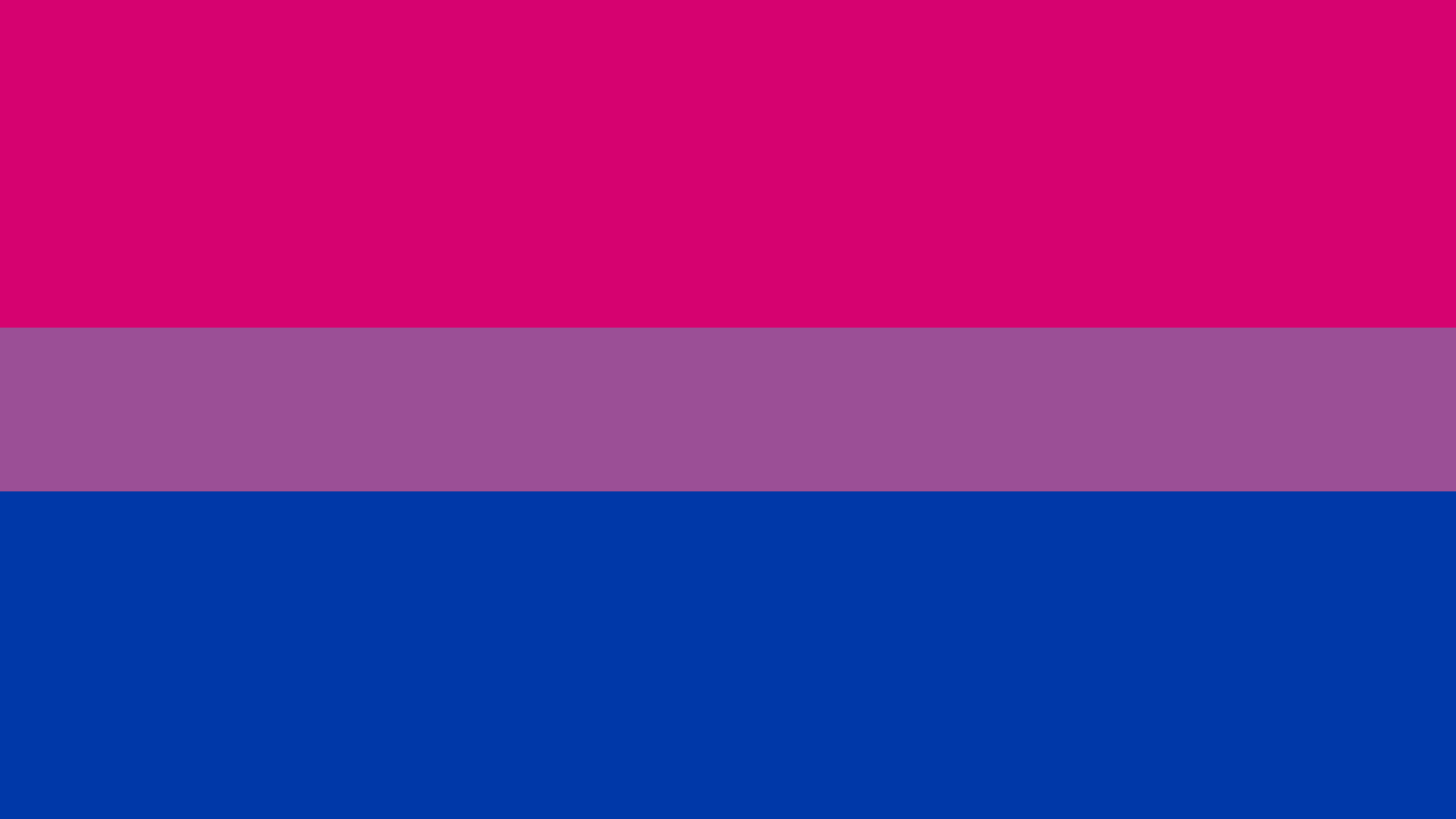
The bisexual flag has three horizontal stripes: magenta pink on top, a narrower lavender purple band in the middle and royal blue on the bottom. Pink represents same-sex attraction and blue represents different-sex attraction, per the Human Rights Campaign. Purple, where the two overlap, is now widely read as attraction to more than one gender.
Bisexual Flag Colors, Proportions and Hex Codes
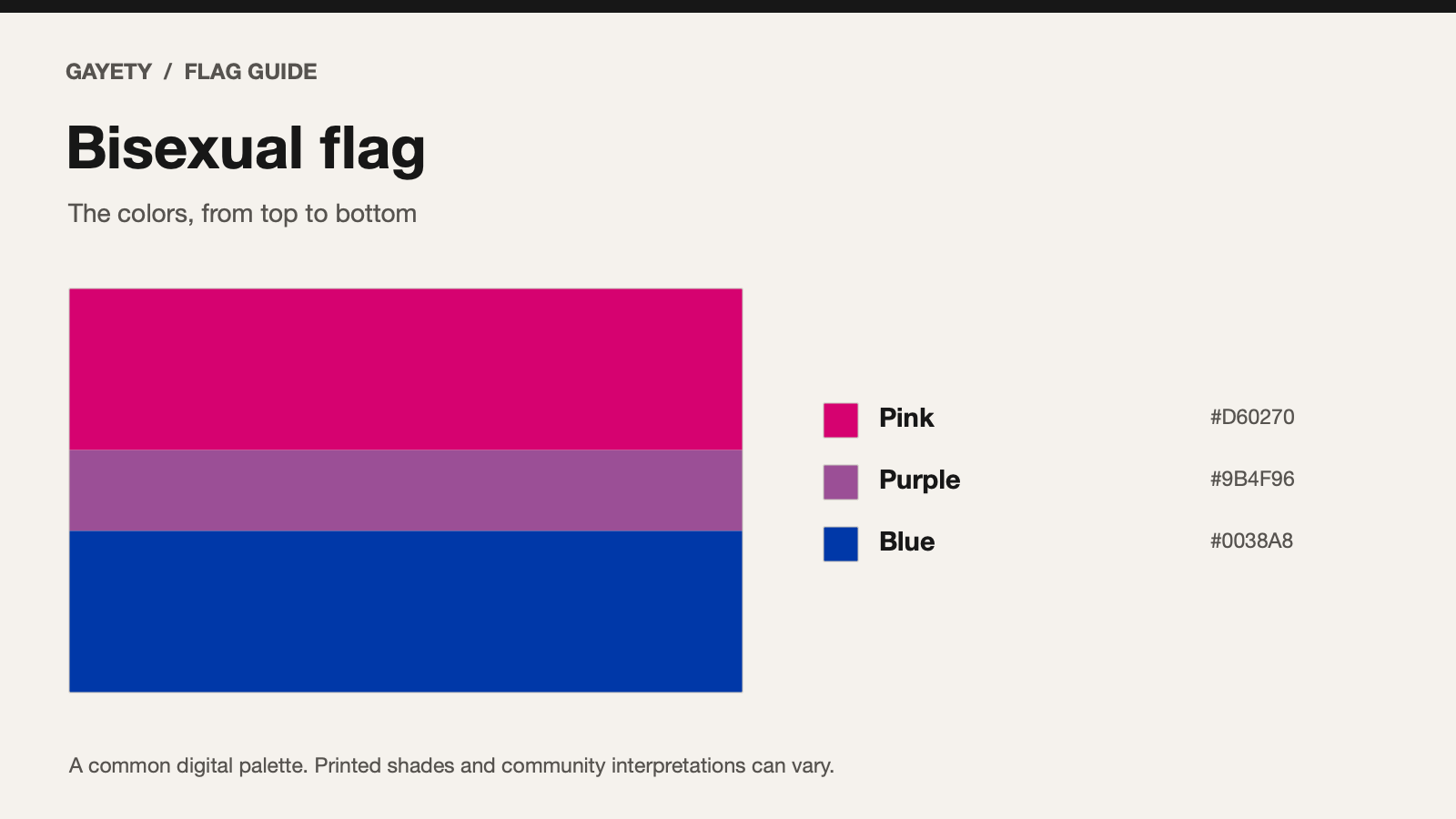
| Stripe | Share of flag | Meaning | Hex code | Pantone |
|---|---|---|---|---|
| Magenta pink (top) | 40 percent | Same-sex attraction | #D60270 | 226 |
| Lavender purple (middle) | 20 percent | Attraction to more than one gender | #9B4F96 | 258 |
| Royal blue (bottom) | 40 percent | Different-sex attraction | #0038A8 | 286 |
Stripe ratio and Pantone numbers are from Flags of the World, hex values from Flag Color Codes. The overall shape isn’t fixed.
What Michael Page Said the Purple Stripe Means
Page called the flag an evolution of an earlier bi symbol: overlapping pink and blue triangles, where the overlap turns purple. He described the lavender stripe as himself, the person in the middle. The purple pixels “blend unnoticeably into both the pink and blue,” he said, quoted by Mental Floss. Bi people blend into gay and straight spaces the same way.
Guides differ on the purple. The Human Rights Campaign says attraction to two genders, Mental Floss says multiple or all genders, and the UC Santa Barbara pride flag glossary includes nonbinary people.
Biangles to BiCafe: Where the Bi Pride Flag Came From
That earlier triangle symbol is the biangles, designed by artist Liz Nania in the mid-1980s, according to Mental Floss. Page, a Florida activist, wanted a bi symbol that could actually fly: the earlier ones weren’t “flaggable on a mass scale,” he said in a note quoted by Flags of the World.
The biangles’ pink triangle echoes the badge the Nazis used to mark gay men in the camps. A bisexual moon symbol was created to avoid the pink triangle, according to a Montgomery College guide to LGBTQ+ symbols. (Our explainer on the bisexual symbol covers the moons, triangles and more.) Praise came quickly: Dr. Fritz Klein called it “A most important new Bi symbol” in BiNet USA’s Winter 1998 newsletter, Flags of the World records.
Flying the Bi Flag: Which Stripe Goes on Top
Pink goes on top in Page’s design. Flags of the World has logged it flown blue side up in Madrid in 2013 and Washington in 2016, and both ways in Saint Petersburg in 2014 and Manchester in 2019.
Compare it with every pride flag and what it means, read our take on whether the bisexual aesthetic is really a thing, or browse more queer culture explainers on Gayety.
Bi Pride Flag FAQ: Colors, Creator and Pride Day
What do the 3 colors of the bisexual flag mean?
Pink, the top stripe, stands for attraction to the same gender, and royal blue, the bottom stripe, for a different gender. Lavender purple in the middle is the overlap: attraction to more than one gender.
Who designed the bisexual flag?
Michael Page, a Florida-based bisexual rights activist, designed the bisexual pride flag. He unveiled it on December 5, 1998, at the first anniversary party of his BiCafe website.
Why is the purple stripe on the bisexual flag thinner?
The purple stripe takes up 20 percent of the flag, while pink and blue each take 40 percent. Page drew it as the overlap, where pink and blue blend into purple.
What is the difference between the bisexual and pansexual flags?
Both put pink on top and blue on the bottom. The bisexual flag has a narrow purple overlap stripe; the pansexual flag, from 2010, has three equal stripes with yellow in the middle.
When is Bisexual Visibility Day?
Bisexual Visibility Day, also called Celebrate Bisexuality Day, falls on September 23 every year. Activists Wendy Curry, Michael Page and Gigi Raven Wilbur started it in 1999, the City of Boston notes.


