




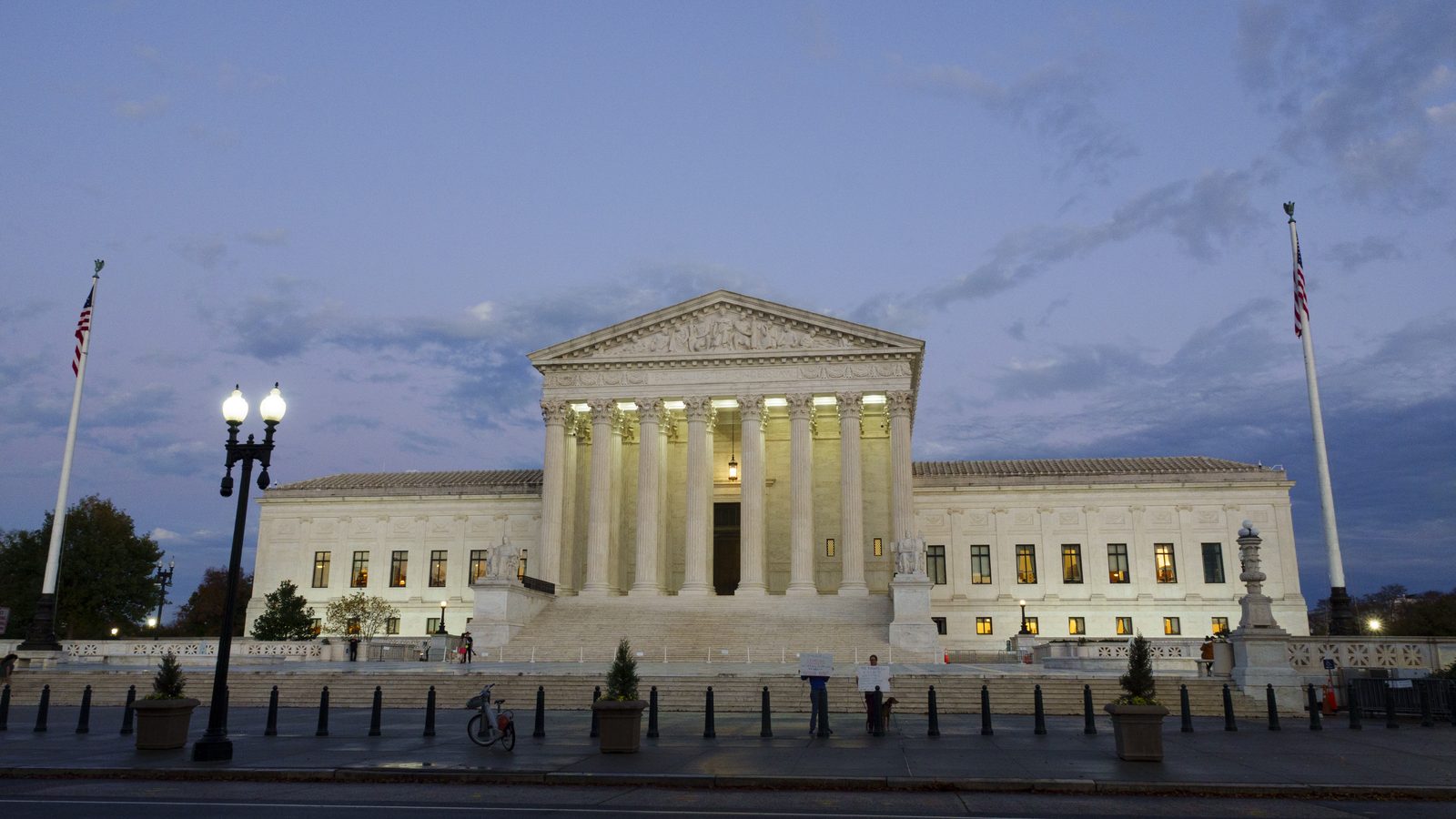
The U.S. Supreme Court on Nov. 9 threw out a federal appeals ruling that had revived a transgender woman’s challenge to how the El Paso County, Colorado, jail housed and searched her.
In Roybal v. Griffith, No. 25-442, the court granted the sheriff’s petition, wiped out the 10th Circuit’s judgment and sent the case back “for further consideration in light of West Virginia v. B. P. J., 609 U. S. 958 (2026), and United States v. Skrmetti, 605 U. S. 495 (2025),” according to the court’s order list.
No justice noted a dissent. No opinion, either.
Solicitor General Sauer Asked the Justices to Send Griffith’s Case Back
The order is a GVR (grant, vacate and remand). Darlene Griffith hasn’t lost on the merits, and the 10th Circuit can land where it did before or somewhere else.
Solicitor General D. John Sauer asked for exactly this in a September brief for the United States.
It also said how the rerun should end: “B.P.J. and Skrmetti dictate ‘the ultimate outcome of the litigation’ and make a GVR ‘appropriate.'”
“If the Tenth Circuit had issued its opinion after B.P.J. and Skrmetti, summary reversal would plainly be warranted,” the brief said.
It referred to Griffith with male pronouns throughout. “Accordingly, respondent’s equal-protection claims must be dismissed,” Sauer wrote.
The court had invited that brief on June 30, after a June 29 conference. (In a separate case in October, the justices left in place a block on a federal prison policy limiting gender-affirming care.)
Darlene Griffith’s Case Against the El Paso County Jail
Griffith entered the jail as a pretrial detainee in the summer of 2020, according to the 10th Circuit’s Feb. 19, 2025, opinion. She’s a transgender woman who has lived openly as a woman for more than 20 years.
“She asked to be housed in a female unit,” the opinion says.
The jail assigned people “on the basis of the individual’s genitalia,” the appeals court said. So she went to a men’s unit, and her requests to move were refused.
Griffith, who is also legally blind, alleged that male deputies searched her. “And the Jail allowed male deputies to search Ms. Griffith without a female deputy present,” the court wrote in summarizing her complaint. She also said the jail denied her women’s underwear and commissary items.
A trial court dismissed the case. On appeal, Judge Veronica Rossman wrote for a divided panel that “Ms. Griffith has stated a plausible Equal Protection claim under 42 U.S.C. § 1983.”
That claim, against the sheriff in his official capacity, came back to life. So did the cross-gender search claims against him and an abusive search claim against one deputy.
The panel leaned on its 2024 Fowler v. Stitt ruling, an Oklahoma birth certificate case, and treated the jail rules as sex classifications that get heightened review. It left the bigger question alone: “we need not also decide in this case whether transgender status is itself a protected class.”
Judge Timothy Tymkovich dissented. “In my view, binding Supreme Court precedent prescribes rational basis review to these sorts of correctional policies,” he wrote.
He argued the fix would backfire. “Her requested relief would impose on others the very consequences she fears, and which the Jail’s policies aim to minimize,” Tymkovich wrote.
The full 10th Circuit refused to rehear the case June 10, 2025, over a Tymkovich dissent joined by two colleagues, according to the sheriff’s petition.
How Skrmetti and B.P.J. Treated Transgender Classifications
Neither case the court cited involved a jail. Both came out against transgender plaintiffs.
United States v. Skrmetti, decided June 18, 2025, upheld Tennessee’s ban on certain gender-affirming care for minors. “SB1 does not classify on the basis of transgender status,” Chief Justice John Roberts wrote, and the law got only rational basis review.
West Virginia v. B.P.J. came down 6-3 on June 30, 2026, upholding West Virginia’s law barring transgender girls from girls’ school sports. Justice Brett Kavanaugh wrote that “in the distinctive sports context, in other words, the States may treat all biological males the same.”
His majority treated the law as a sex classification that passed intermediate scrutiny. On classifications based on transgender status, it said “we need not definitively resolve whether rational basis review or intermediate scrutiny applies,” because the law passed either test.
Griffith’s Lawyers Argued a Remand Wasn’t Needed
The sheriff’s lawyers at First & Fourteenth in Colorado Springs wanted the justices to settle how judges review sex-based prison rules. “Lower courts have split at least three ways on the level of constitutional scrutiny,” the petition said.
The petition read the search ruling as barring male officers from searching transgender women except in emergencies. “Such a rule is constitutionally absurd,” it said. “The Tenth Circuit’s new rule is unworkable and forces a lose-lose on prison officials and officers,” the petition argued.
It noted the court had already vacated Fowler in a June 30, 2025, order citing Skrmetti.
Twenty-three states and the Arizona Legislature, led by Kansas, filed a brief backing the sheriff.
Devi Rao of the Roderick & Solange MacArthur Justice Center led Griffith’s lawyers, with Denver’s Newman McNulty. “The decision below was factbound, correct, and preliminary,” their brief in opposition said.
They argued “intervention now is both premature and unnecessary, even as to this particular case, making it a poor vehicle.”
“There is absolutely no need for this Court to grant, vacate, and remand,” they wrote.
The court did it anyway. Now the 10th Circuit decides whether Griffith’s claims survive the new precedents. Her lawyers had noted the jail still has arguments to make: “Petitioners remain free to assert their penological justifications on remand.”

