
Updated Nov. 12, 2026: corrected the flag’s origin and refreshed sources.
The bigender flag is a set of pink, purple, white and blue stripes that stands for people with two genders. It shows up on Pride pins, profile pictures and flag guides from colleges and advocacy groups. One thing it doesn’t have is a documented creator.
The Human Rights Campaign‘s Pride flag guide puts it plainly: “The creation of the Bigender Pride Flag is unknown.” Here’s what the colors mean, where the origin story falls apart and which variants you’ll run into online.
What the Bigender Flag Looks Like
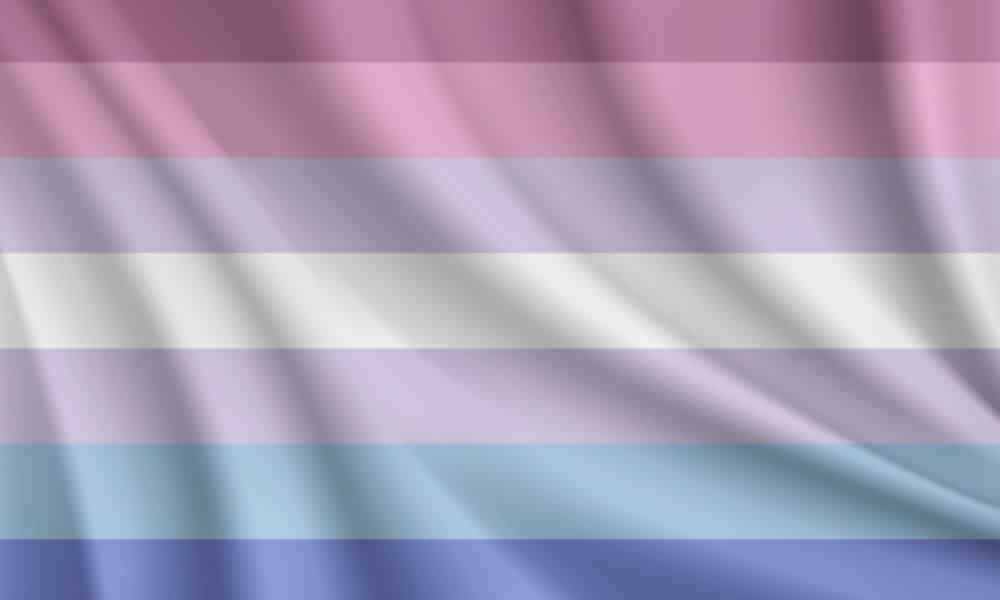
The version you’ll see in most flag guides runs from dark pink at the top to dark blue at the bottom. Lighter pink and purple sit in between on one side, purple and light blue on the other. A single white stripe holds the center.
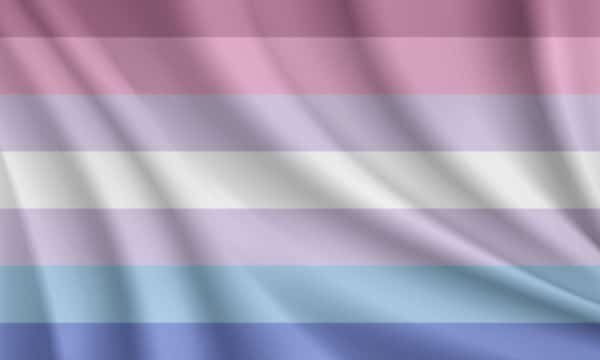
The layout is symmetrical on purpose. Feminine colors sit at one edge, masculine colors at the other, and the stripes meet in the middle. It reads like a gradient between two points, which is a fair visual summary of the identity.
What Each Bigender Flag Color Means
HRC’s guide doesn’t assign meanings to the stripes. Worcester Polytechnic Institute’s flag and terms guide does. Here’s its breakdown:
- Dark pink: femininity
- Light pink: feminine-leaning
- Purple: androgyny, a mixture of femininity and masculinity
- White: nonbinary identities
- Light blue: masculine-leaning
- Dark blue: masculinity
Bergen Community College’s Pride flag guide uses a simpler four-color reading (pink, purple, white and blue) and adds one detail: the white center stripe is “inspired by the Transgender Pride Flag.”
These meanings come from flag guides, not from a statement by a designer. With no known creator, nobody can say what the original intent was. Treat the color key as the community’s working definition.
Who Created the Bigender Flag? Nobody Has Confirmed It
Plenty of flags have a paper trail. HRC says the genderfluid flag was “developed in 2013 by JJ Poole,” for example. The bigender flag has no equivalent record. It spread online, picked up a color key and became the default without a confirmed designer attached.
An earlier version of this article credited a specific Tumblr account and repeated claims about that person. Gayety couldn’t confirm the attribution through a reliable source, and the claims were never documented. Both have been removed.
If you see a flag guide name a creator with total confidence, check where that name came from. When Gayety checked, those names traced back only to fan wikis and old social posts, not a verifiable record.
Bigender Flag Variants With Yellow and Black Stripes
You’ll also find other striped flags labeled bigender. One five-stripe design uses pink, yellow, white, purple and blue. A six-stripe design adds black. The one pictured below pairs yellow, white, pink, blue, purple and black.
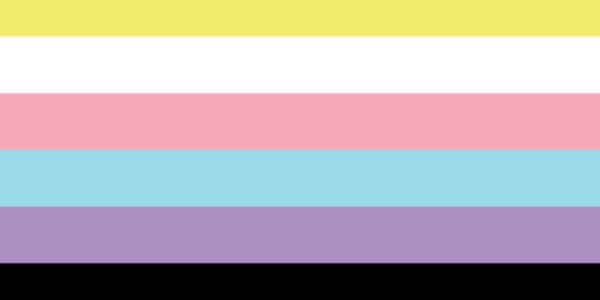
No reliable source documents who made these variants or what their extra colors mean. You’ll see confident explanations online (yellow for genders outside the binary, black for agender people), but those are interpretations. They aren’t a designer’s stated intent.
Some bigender people also draw their own versions, usually shifting the shades of the same pink, purple and blue palette. That’s common across Pride flags. Personal flags are fine. They just aren’t the version a reader means when they search for “bigender flag.”
What Bigender Means, in Brief
The Trans Journalists Association defines bigender as “a word to describe someone’s gender that often means someone who has two genders.” It adds, “These genders can be, but are not always, man and woman.” HRC notes that the two identities “can occur at the same time or they can vary over time.”
GLAAD lists bigender among the words some nonbinary people use “to describe the specific way in which they are nonbinary.” For the colors of that wider umbrella, see Gayety’s guide to the nonbinary flag. If someone’s gender shifts more broadly, the genderfluid flag may fit better.
Bigender vs. Bisexual
The shared prefix trips people up. Bigender describes gender identity. Bisexual describes attraction. As GLAAD puts it, “Gender identity and sexual orientation are not the same.” A bigender person can be gay, straight, bi, asexual or anything else.

Bigender vs. Transgender
Some bigender people consider themselves transgender. Others don’t. GLAAD says “many nonbinary people also call themselves transgender and consider themselves part of the transgender community,” then adds, “Others do not.” Go by the label a person uses.

Bigender Flag FAQ
Is There an Official Bigender Flag?
No organization governs Pride flags. The pink, purple, white and blue design is the one HRC, WPI and Bergen Community College list, so it’s the closest thing to a standard.
Why Does the Bigender Flag Have a White Stripe?
WPI says white stands for nonbinary identities. Bergen Community College says the center stripe was inspired by the Transgender Pride Flag, which also puts white in the middle.
Can Bigender People Use Other Pride Flags?
Yes. Many fly the nonbinary or transgender flag instead of, or alongside, the bigender flag. No flag is required to claim an identity.