



World AIDS Day 2026 is Tuesday, Dec. 1. The UNAIDS theme this year is “Ending AIDS starts with access,” and it lands as global HIV funding falls and U.S. budgets for the current fiscal year remain unsettled.
The date never moves. “Founded in 1988,” World AIDS Day “was the first ever international day for global health,” UNAIDS says.
When Is World AIDS Day 2026?
Dec. 1, every year. This time it’s a Tuesday. The first one ran on Dec. 1, 1988.
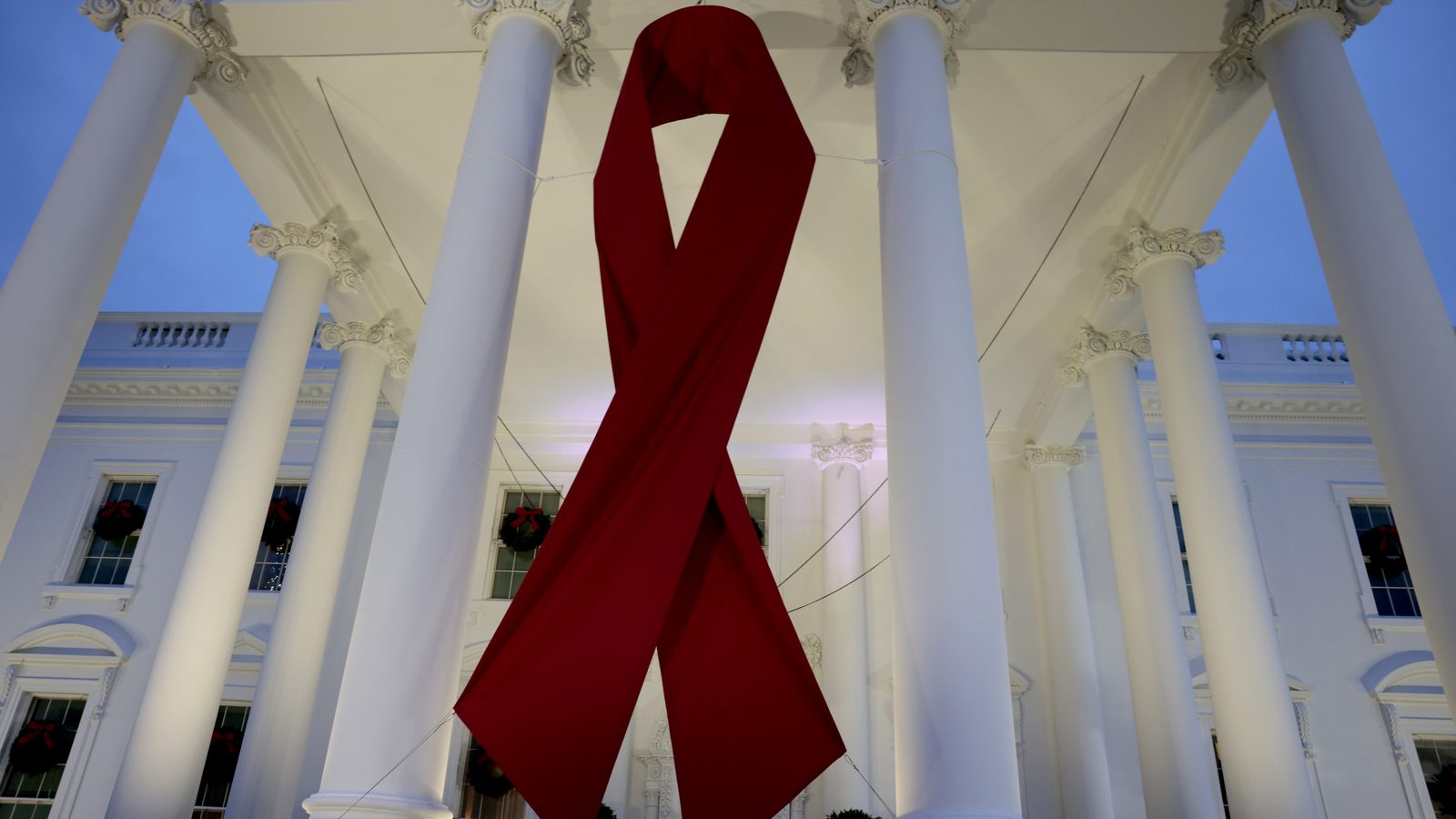
Local groups run testing drives and Quilt displays. UNAIDS wants people to “wear the red ribbon, learn where access is missing in your community, and add your voice,” then share the campaign with #WorldAIDSDay.
UNAIDS 2026 Theme: ‘Ending AIDS Starts With Access’
The tests, pills and shots already exist. “The theme of this year’s World AIDS Day is access,” the UNAIDS campaign page says.
“Without access, the world will not end AIDS,” it says, and further down, “Science only saves lives when it reaches people.”
UNAIDS Executive Director Winnie Byanyima put it harder in a July 27 press release: “innovation without access is not innovation, it is injustice.”
For many gay and bisexual men and trans people, the wall is legal. Same-sex sexual acts are criminalized in 66 countries, UNAIDS says, and stigma and punitive laws keep people out of clinics.
“You cannot end AIDS while criminalizing people living with and most at risk of HIV,” Byanyima said in the same release. “When people fear arrest, violence or discrimination, they stay away from HIV services.”
How James Bunn and Thomas Netter Chose Dec. 1, 1988
World AIDS Day was born inside WHO. Two of its public information officers, James “Jim” Bunn and Thomas Netter, came up with it in 1987, CBS News Bay Area reported.
Before WHO borrowed him, Bunn covered AIDS full time as a reporter at KPIX in San Francisco. “We became the reputable source because we were so dogged in the pursuit of the story,” he said in the station’s report.
He brought that playbook with him. “That World AIDS Day model was actually patterned after the experiences we had with AIDS lifeline,” Bunn said.
The date was a media call. Bunn and Netter knew Dec. 1 sat in the news lull between Thanksgiving and the winter holidays, so coverage was more likely, CBS reported.
Red Ribbon Meaning: The 1991 Visual AIDS Project
The red ribbon came out of the Visual AIDS Artists’ Caucus over meetings in April and May of 1991. Red meant blood, and it meant passion, which the artists read as both anger and love, Visual AIDS says.
The original instructions were short: “cut the red ribbon in 6 inch length, then fold at the top into an inverted ‘V’ shape.”
Nobody signed it. The artists credited the caucus as a whole and set out to “keep the image copyright free, so that no individual or organization would profit from the use of the red ribbon,” Visual AIDS says.
“The ribbon has never been copyrighted in the United States,” its project page adds.
In June 1991, working with Broadway Cares/Equity Fights AIDS, the caucus got ribbons onto guests and presenters at the 45th Tony Awards. “One of the first presenters to wear the iconic symbol was Jeremy Irons,” Visual AIDS says.
UNAIDS now calls it “the universal symbol of awareness of, support for and solidarity with people living with HIV.”
The AIDS Memorial Quilt, From 1,920 Panels to Nearly 50,000
Cleve Jones made the first panel for his friend Marvin Feldman, according to the National AIDS Memorial’s history of the Quilt.
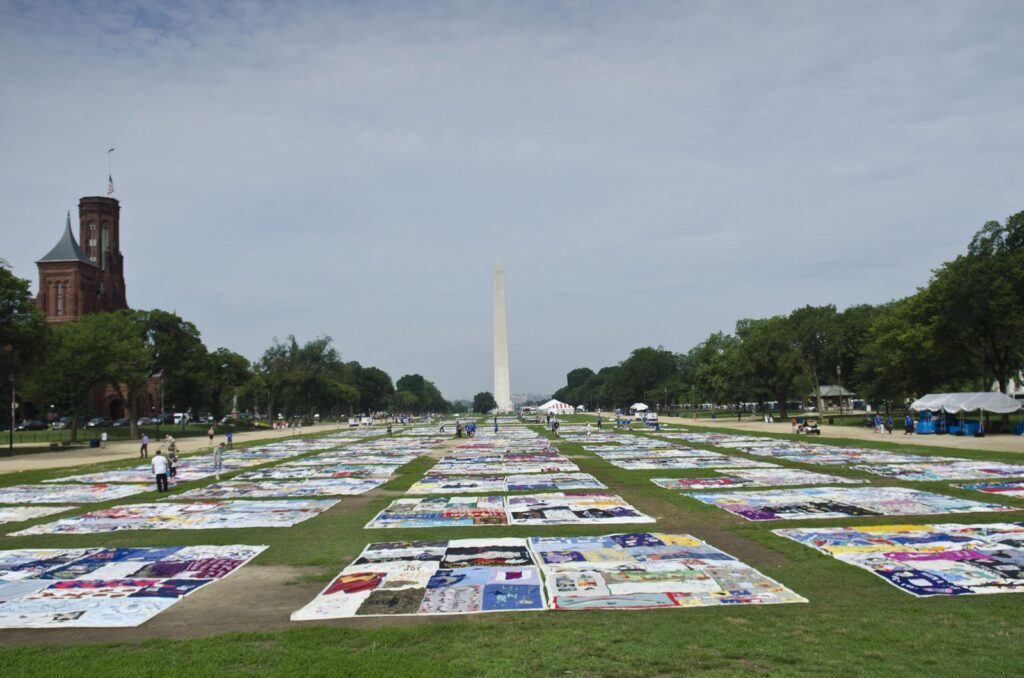
It hit the National Mall on Oct. 11, 1987, during the National March on Washington for Lesbian and Gay Rights. That first display had 1,920 panels. About half a million people came that weekend.
The last full display on the Mall was October 1996. An estimated 1.2 million people came to see it.
Today the Quilt weighs 54 tons. Nearly 50,000 panels honor more than 110,000 people.
The National AIDS Memorial in San Francisco took it on as permanent caretaker in November 2019. When the memorial put the Quilt online during the Covid-19 pandemic in 2020, CEO John Cunningham said that “during the darkest days of the AIDS crisis, the Quilt was a source of immense comfort.”
Global HIV Statistics in the UNAIDS July 2026 Fact Sheet
UNAIDS updated its global fact sheet on July 27, 2026, with estimates for 2025. “Despite enormous challenges ending AIDS is still within reach,” Byanyima said that day.
- People living with HIV: 41.0 million
- People who acquired HIV: 1.2 million (down 42% since 2010)
- AIDS-related deaths: 570,000 (down 57% since 2010)
- People on HIV treatment: 32.1 million (78%)
- Higher risk of acquiring HIV, gay men and other men who have sex with men: 18 times all adults 15 to 49
- Higher risk of acquiring HIV, transgender women: 17 times all adults 15 to 49
Those are global group comparisons. They aren’t a forecast for any one gay man or trans woman.
Donors are pulling back. International HIV financing fell from $8.8 billion in 2024 to $7.3 billion in 2025, an 18% drop and, in UNAIDS’ words, “the lowest level in nearly two decades.”
“The era of relying on international aid is over,” Byanyima said. “Countries cannot wait and they cannot go backwards.”
CDC’s 2026 Update on HIV Diagnoses in the U.S.
In 2024, CDC counted 38,793 HIV diagnoses among people 13 and older in the United States and seven territories and freely associated states. Its May 18, 2026, report, “HIV Diagnoses, Deaths, and Prevalence: 2026 Update,” carries a warning label: “Data are provisional with a 12-month reporting delay.”
Gay, bisexual and other men who have sex with men make up the largest share. CDC attributed 65% of diagnoses, or 25,129, to male-to-male sexual contact.
Black people accounted for 39% of diagnoses, CDC reported. Hispanic or Latino people were 34%, and people 25 to 34 made up 37%.
These aren’t new infections. A diagnosis can come long after someone acquired HIV.
At the end of 2024, 1,158,701 people were living with diagnosed HIV in those areas. A companion report, “National HIV Prevention and Care Objectives: 2026 Update,” found 68.5% of people 13 and older with diagnosed HIV “had viral suppression during 2024.”
That’s the number that stops transmission. People who keep an undetectable viral load “will not transmit HIV to their HIV-negative partners through sex,” HIV.gov says. That’s U=U.
PEPFAR and U.S. HIV Funding Status as of Nov. 10
PEPFAR’s authorization lapsed last year. “That authorization expired on March 25, 2025,” KFF’s PEPFAR fact sheet says, though the program stays in U.S. law and runs as long as Congress funds it. PEPFAR reports saving an estimated 26 million lives, KFF notes.
The administration “dissolved USAID and integrated remaining USAID global health activities” into the State Department’s global health office, KFF says. Its America First Global Health Strategy is “anchored in bilateral health agreements with countries,” with the U.S. aiming to reduce its funding over time.
For fiscal 2026, Congress passed the Consolidated Appropriations Act, 2026, and the president signed it Feb. 3, 2026. KFF’s preliminary estimate puts PEPFAR at about $6 billion for the year.
HIV doctors called the package’s Labor-HHS bill a win at home. It “preserves funding for HIV prevention, care and research,” the HIV Medicine Association said.
Fiscal 2027 began Oct. 1 without full-year bills, so agencies run on a stopgap, the Continuing Appropriations and Extensions Act, 2027, which the president signed Sept. 2 and which lasts through Dec. 11.
“But lawmakers must pass a government funding bill before Dec. 11 to avoid another shutdown,” States Newsroom reporters Jennifer Shutt and Shauneen Miranda wrote Nov. 9. They reported that another stopgap is likely.
The cuts on the table are proposals, not law. The White House’s fiscal 2027 request would put the Global Health Programs account at “$5.1 billion in the request, $4.3 billion below the FY 2026 amount ($9.4 billion),” KFF reported.
At home, “Funding for core HIV prevention programs at the CDC is eliminated in the budget request,” KFF found.
The House Appropriations Committee’s Labor-HHS bill, approved June 9, would also end CDC’s domestic HIV prevention program and cut Ryan White by $224.9 million, HIVMA reported. The Senate hadn’t acted on it as of the Committee for a Responsible Federal Budget’s Sept. 3 tracker.
One U.S. global commitment is growing. On April 14, the Global Fund and the United States set a joint goal of reaching 3 million people with lenacapavir, the twice-yearly prevention shot, by 2028.
Ways to Mark World AIDS Day on Dec. 1
Get tested. CDC’s GetTested locator finds HIV, STI and hepatitis testing near you, and HIV.gov runs a service locator for testing and care.
Look at PrEP. CDC says PrEP “greatly reduces your chance of getting HIV from sex or injection drug use.” The FDA approved Yeztugo, the twice-yearly lenacapavir shot, on June 18, 2025. Gayety covered new data on how many people stuck with the shot versus daily pills.
“We also know that, in research, many people who need or want PrEP preferred less frequent dosing,” Dr. Carlos del Rio of Emory University School of Medicine said in Gilead’s approval release.
Find a name on the Quilt. The National AIDS Memorial lets you search the Quilt by name, make a panel or request a display for your community.
Go to an event. The National AIDS Memorial is holding its World AIDS Day 2026 observance in the Grove in San Francisco on Dec. 1. “Join us in the Grove on Tuesday, December 1st as we gather to heal, hope, and remember,” the memorial says. Dr. Anthony Fauci and Dafina Ward are among its listed panelists.
Gayety has also covered HIV Unwrapped at New York Fashion Week, and how France ran 9 million HIV tests in 2025 as diagnoses fell.
World AIDS Day FAQ: Date, Color and Red Ribbon Meaning
When is World AIDS Day? Dec. 1, every year. In 2026 it’s a Tuesday.
What color is World AIDS Day? Red, for the ribbon. Visual AIDS artists picked it in 1991 for blood and passion.
What does the red ribbon mean? Awareness of, support for and solidarity with people living with HIV, in UNAIDS’ words. WHO says the day itself also commemorates people who have died.
What is the World AIDS Day 2026 theme? “Ending AIDS starts with access,” from UNAIDS. The 2025 theme was “Overcoming disruption, transforming the AIDS response,” according to the World Health Organization.

