





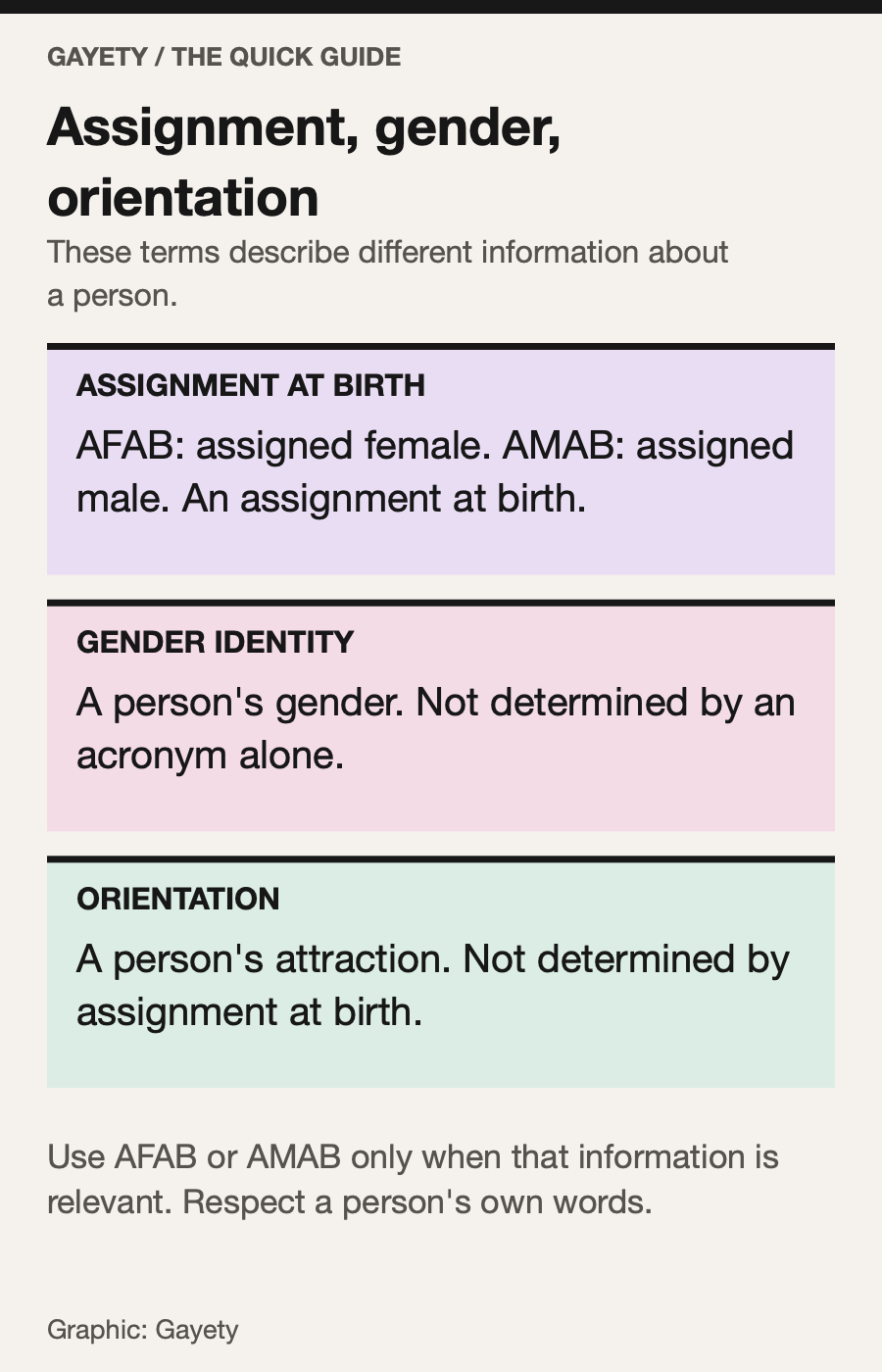
AFAB stands for assigned female at birth. AMAB stands for assigned male at birth. UC Berkeley’s Gender Equity Resource Center gives the AFAB meaning in its glossary and adds that the two terms “are most frequently used to designate a gender assigned at birth.”
AFAB and AMAB Definitions From TJA, NLGJA and UC Berkeley
- Trans Journalists Association stylebook: the sex marker a person gets from anatomy and other physical traits seen at birth. Birth sex and natal sex are rough equivalents. Biological sex needs more context.
- NLGJA’s Stylebook on LGBTQ+ Terminology: how doctors, parents or others classify a baby as male, female or intersex, going by visible genitalia.
- UC Berkeley’s Gender Equity Resource Center: one-line glossary entries for AFAB and AMAB, with the gender framing quoted above.
- Assigned gender at birth, a related phrase TJA lists: whether a newborn was deemed a boy or a girl. Assigned sex generally refers to anatomy.
The terms describe an assignment, not a person’s gender now. Someone assigned female at birth may be a cisgender woman, a trans man or nonbinary. Someone assigned male at birth may be a cis man, a trans woman or nonbinary. Neither abbreviation tells you someone’s pronouns.
Where ‘Assigned at Birth’ Came From: Intersex Medicine to Trans Theory
Jessica A. Clarke, then a Vanderbilt law professor, traced the phrase for “Sex Assigned at Birth,” a 2022 Columbia Law Review article. Her timeline, roughly:
- 1960: a urology article already writes about assigning sex at birth, part of midcentury medical research on intersex people.
- 1990s: trans theorists borrow the language to describe how all infants get sorted.
- Early 2000s: the phrase starts showing up in legal contexts.
The 2016 Affordable Care Act regulations defined gender identity with reference to sex assigned at birth, and the proposed 2021 Equality Act used “designated sex at birth.”
Over the past two decades, trans rights advocates have taken up “sex assigned at birth” to replace “biological sex,” Clarke writes. She also argues that “biological sex” rose to prominence to lend scientific cover to efforts denying trans identities. State laws that used it, as of 2022, had no consistent definition.
How Researchers Ask About Sex Assigned at Birth
In March 2022, a National Academies committee recommended that NIH standardize the questions used to collect sex and gender data. Its suggested two-step approach asks about sex assigned at birth separately from current gender. The report also advises collecting information about specific sex traits only when they are relevant to the research.
A form asking only “male or female” can leave its purpose unclear. Is it asking about a birth record, a current identity document, gender or a health-related characteristic? Those answers need not be the same. Researchers need to explain what they are measuring and why.
When to Use AFAB and AMAB, and Phrases to Skip
TJA’s rules for the two phrases:
- Fine where they add precision, as in stories about health care or legal documents. The phrases “evoke a specific set of medical and legal circumstances,” TJA says.
- Fine for the categories in general.
- Not fine as a label for a trans person who doesn’t use it. Not every trans person is comfortable being called assigned male or female at birth.
| Instead of | Try | Source |
|---|---|---|
| “an AFAB,” “the AMABs” | AFAB people, people assigned male at birth | TJA calls the noun form widely offensive |
| “born a girl,” “born male” | assigned female at birth; “raised as a girl” when accurate | TJA |
| “biological male” for a trans woman | trans woman | TJA, NLGJA |
| “male-bodied,” “female-bodied” | specific terms, such as people with ovaries | TJA |
| MtF, FtM | trans woman, trans man, transfeminine, transmasculine | TJA calls MtF and FtM outdated |
The two stylebooks don’t fully agree on the abbreviations. NLGJA’s advice is to “generally avoid the abbreviations” and write the phrase out. I’d stick to using AFAB or AMAB about yourself, or about someone who’s said it about themself.
Some bigender, genderqueer and nonbinary people use AFAB or AMAB when describing their experiences. The abbreviations refer to an assignment made at birth, not a complete description of their identities or current bodies. More gender terms are in Gayety’s LGBTQ+ culture section.
Why AFAB and AMAB Cannot Describe Every Body
A birth assignment does not tell you which organs someone has now, their hormone levels or what care they need. Bodies and medical histories vary. When a specific trait matters, name that trait instead of treating AFAB or AMAB as a substitute for it.
The National Academies report distinguishes gender data from sex traits and recommends gathering the information a study actually needs. In everyday conversation, there is usually no reason to ask someone about an assignment made at birth. Their name, gender and pronouns are enough.
AFAB Meaning FAQ: Labels, Pronouns and Biological Sex
What does AFAB stand for?
Assigned female at birth. NLGJA describes the assignment as a call doctors, parents or others make from visible genitalia. AFAB people can be women, men or nonbinary.
What does AMAB mean?
Assigned male at birth. That covers a cis man and a trans woman alike, since the term says nothing about current gender.
Is it offensive to call someone AFAB or AMAB?
Sometimes. TJA says not to label a trans person AFAB or AMAB unless they use the term, and it calls noun forms like “an AFAB” widely offensive.
Is AFAB a gender identity?
No. It’s a sex assignment made at birth. An AFAB person can be a woman, a trans man, nonbinary or bigender.
Is AFAB the same as biological female?
Not quite. TJA and NLGJA both advise against “biological female” for trans people, and TJA prefers assigned sex at birth outside medical literature.

