



Camp finds pleasure in exaggeration, theatricality and things that refuse to behave tastefully. Think extravagant costumes, gloriously artificial performances and a dramatic gesture held just a little too long. Calling something “campy” often means enjoying how much it commits to being too much.
That is the useful starting point. The arguments begin when we ask whether camp must be deliberate, queer or political. Susan Sontag gave those arguments a famous framework in 1964. Drag performers, historians and queer critics have kept them going ever since.
I find camp easier to understand through examples than through rules. A joke can be camp. So can a performance that takes itself completely seriously. The audience’s affection matters as much as the spectacle.
Camp Meaning: How to Use the Word
Merriam-Webster defines one sense of camp as “a style or mode of personal or creative expression that is absurdly exaggerated.” The dictionary also connects it with amusing artificiality and exaggerated mannerisms. Those definitions describe qualities we might recognize in clothes, films, décor or a person’s delivery.
As a noun, camp names the style or sensibility: “That performance is pure camp.” As an adjective, camp or campy describes it: “a campy costume.” To “camp it up” means to perform with more exaggeration or theatrical flourish.
Those examples help with everyday usage. They cannot settle whether a particular red-carpet look succeeds as camp. A huge dress gives us scale. Camp also depends on the attitude, the context and the pleasure we take in it.
Where Did Camp Come From?
The word’s origin remains uncertain. Merriam-Webster’s etymology discusses a possible connection with the French se camper, meaning to strike a bold pose. It also cautions that the route from French into English is unclear.
The queer history is easier to trace. Britain’s National Archives documents an 1868 letter using “campish”. Frederick “Fanny” Park wrote it decades before Sontag’s essay. Camp belonged to queer life long before a museum gala put it on a dress code.
Susan Sontag’s ‘Notes on Camp,’ Explained
Partisan Review published Sontag’s essay in 1964. Boston University preserves the original magazine pages. She dedicated its 58 numbered notes to Oscar Wilde. The format leaves room for examples, contradictions and changes of direction.
Her defining phrase is “love of the unnatural: of artifice and exaggeration.” For Sontag, camp involves a way of seeing as well as qualities found in objects and performances. The elaborate surface, the stylized gesture and the extravagance become sources of enjoyment.
Her examples include Tiffany lamps, Aubrey Beardsley drawings, Swan Lake, Bellini’s operas and singer La Lupe. I would start with that range. Camp stretches across decoration, classical art and popular entertainment; it cannot fit inside one celebrity’s wardrobe.
Affection is crucial to her account. We can relish an overblown performance without sneering at the person giving it. That distinction helps explain why calling something camp can sound like a compliment, even when it looks ridiculous.

Is Camp Gay? The Queer History and the Debate
Camp has deep roots in gay culture. Sontag acknowledged gay people’s central role while arguing that camp taste and homosexuality were not identical. She also described camp as detached from politics. Later scholars challenged that separation.
Esther Newton’s 1972 Mother Camp studied drag performers and their world. In a 2021 chapter on camp and drag, Simon Dodi discusses Newton’s attention to incongruity, theatricality and humor. He also considers objections to accounts that overlook camp’s lineage within queer communities.
Moe Meyer’s 1994 collection, The Politics and Poetics of Camp, examines camp as queer cultural critique. From that perspective, a performance can challenge the rules around gender, status and respectable behavior while making people laugh.
That disagreement is worth keeping in view. Camp’s mainstream popularity does not erase its queer history. Nor does every queer person share the same taste. We can recognize the tradition without turning it into a personality test.
Camp vs. Kitsch: What’s the Difference?
Kitsch often describes objects or styles considered sentimental, tacky or in questionable taste. Camp can describe an object, a performance or the way an audience enjoys either. The categories overlap, so a souvenir or a melodrama can invite different readings.
Imagine a sentimental porcelain ornament. Someone might call it kitsch. Displaying it in a wildly elaborate shrine, with complete devotion to its tiny grandeur, could create a camp effect. The effect depends on the presentation and the audience.
I would ask what creates the pleasure. Are we enjoying the artificiality, the theatrical excess or the extravagant seriousness? Merely dismissing something as ugly tells us very little. A costly gown can be camp, and an inexpensive keepsake may have nothing camp about it.
Camp in Drag, Divas and Fashion
In drag, camp can emerge through an outsized character, an unlikely costume or a joke performed with fierce commitment. A tiny setback becomes a diva’s catastrophe. An ordinary entrance becomes an event. The scale of the response creates the humor.
Drag also includes many other approaches to performance. Not every queen aims for camp, and camp does not require drag.
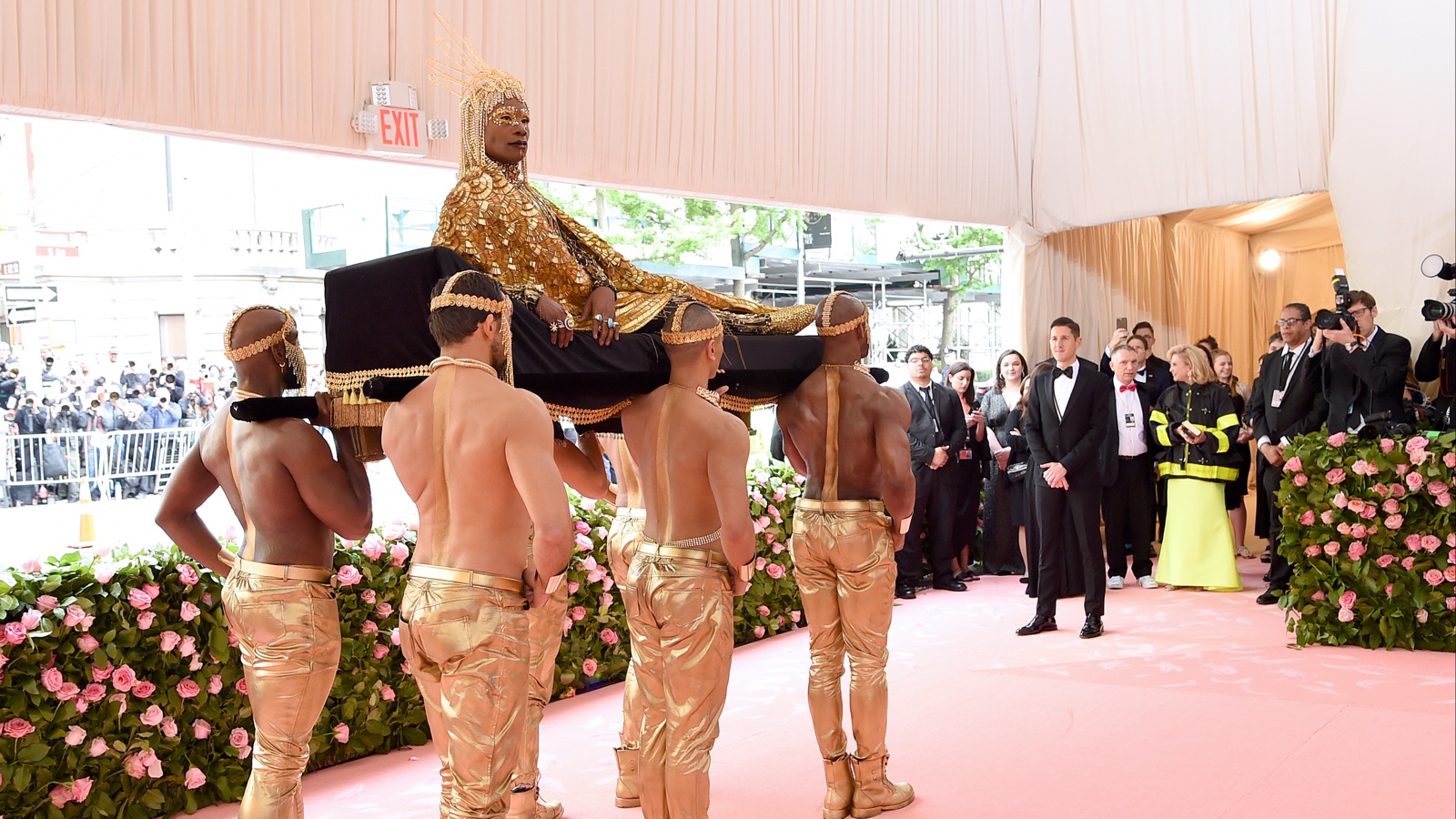
The 2019 Met Gala and ‘Camp: Notes on Fashion’
The 2019 Met Gala took place on May 6. It celebrated the Costume Institute exhibition Camp: Notes on Fashion, which used Sontag’s essay as its framework. Lady Gaga, Harry Styles and Serena Williams were among the evening’s co-chairs.
The exhibition ran from May 9 through September 8, 2019. Andrew Bolton organized it with Karen Van Godtsenhoven and Amanda Garfinkel. Around 250 objects, dating from the 17th century onward, placed fashion alongside other art forms. The museum’s gallery tour shows how that argument worked through clothes.
Camp FAQ
What does campy mean?
Campy describes something exaggerated, theatrical or artificial in an entertaining way. The effect may be intentional, but audiences can also find camp pleasure in something created with complete seriousness.
What is Susan Sontag’s ‘Notes on Camp’ about?
Sontag’s 1964 essay describes camp through 58 numbered notes. It explores artifice, exaggeration and a way of appreciating style. She dedicated the essay to Oscar Wilde.
What is the difference between camp and kitsch?
Kitsch often refers to sentimental or supposedly tasteless objects and styles. Camp involves theatricality and a particular kind of enjoyment. They can overlap, but price and bad taste do not draw a reliable boundary.
What was the camp theme at the 2019 Met Gala?
The May 6, 2019, gala celebrated the exhibition Camp: Notes on Fashion. Susan Sontag’s 1964 essay provided its framework. The exhibition explored camp through fashion and other art forms.
Is camp a gay thing?
Camp has deep roots in queer culture, especially in traditions of performance and coded expression. Critics disagree about whether camp must always be queer or political. Its broader use does not erase that history.


